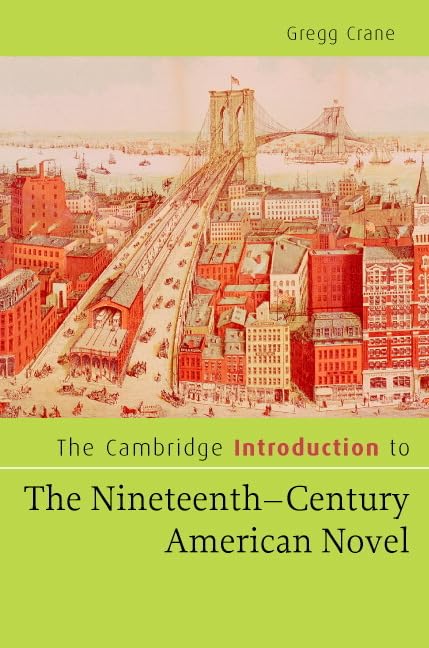
The Cambridge introduction to the nineteenth-century American novel / Gregg Crane.
Material type: TextLanguage: English Series: Cambridge introductions to literaturePublisher: Cambridge, UK ; New York : Cambridge University Press, 2007Description: ix, 238 p. 24 cmISBN:
 - 9780521843256
- 0521843251
- 9780521603997
- 0521603994
- 813.409 22
| Cover image | Item type | Current library | Home library | Collection | Shelving location | Call number | Materials specified | Vol info | URL | Copy number | Status | Notes | Date due | Barcode | Item holds | Item hold queue priority | Course reserves | |
|---|---|---|---|---|---|---|---|---|---|---|---|---|---|---|---|---|---|---|
| Book | Högskolan Väst Övre plan / Upper floor | 813.4 Crane | Available | 6004300008002 |
Includes bibliographical references (p. 220-230) and index.
Acknowledgments 11 --Introduction 12 --The Early American Novel 23 --1 The Romance 64 --What is Romance? 64 --Historical Romance 77 --Philosophical Romance 149 --Sensational Romance 206 --2 The Sentimental Novel 224 --What is the Sentimental Novel? 224 --Theme and Variations: a Young Woman's story 244 --Sentiment and Reform 271 --The Sentimental Novel and the Argument against Reform 293 --Sentiment, Upward Mobility, and the African American Novel 302 --Moving toward Realism 319 --3 The Realist Novel 330 --What is American Literary Realism? 330 --Realist Technique and Subject Matter. 349 --Tensions, Divergences, and Extremes within Realism 377 --The Taste for Excess -- Sensationalism Redux 429 --Works cited 469
"Stowe, Hawthorne, Melville, and Twain: these are just a few of the world-class novelists of nineteenth-century America. The nineteenth-century American novel was a highly fluid form, constantly evolving in response to the turbulent events of the period and emerging as a key component in American identity, growth, expansion and the Civil War. Gregg Crane tells the story of the American novel from its beginnings in the early republic to the end of the nineteenth century. Treating the famous and many less well-known works, Crane discusses the genre's major figures, themes and developments. He analyses the different types of American fiction - romance, sentimental fiction, and the realist novel - in detail, while the historical context is explained in relation to how novelists explored the changing world around them. This comprehensive and stimulating introduction will enhance students' experience of reading and studying the whole canon of American fiction." http://www.loc.gov/catdir/enhancements/fy0729/2007014638-d.html.