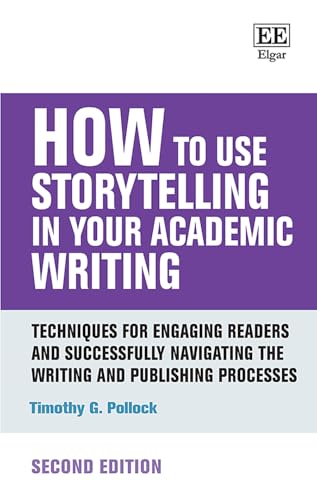
How to use storytelling in your academic writing : techniques for engaging readers and successfully navigating the writing and publishing processes / Timothy G. Pollock, Haslam Chair in Business and Distinguished Professor of Entrepreneurship, Department of Management and Entrepreneurship, Haslam College of Business, University of Tennessee-Knoxville, USA.
Material type: TextLanguage: English Series: How to guidesPublisher: Cheltenham, UK ; Northampton, MA : Edward Elgar Publishing, [2025]Copyright date: ©2025Edition: Second editionDescription: xi, 243 pages illustrations 25 cmContent type:
 - text
- unmediated
- volume
- 9781035325900
- 103532590X
- 9781035325887
- 1035325888
- 808.06/6378 23
- LB2369
| Item type | Current library | Call number | Status | Barcode | |
|---|---|---|---|---|---|
| Book | Högskolan Väst Övre plan / Upper floor | 808.066378 Pollock | Available | 6004300077183 |
Includes bibliographical references (pages 226-232) and index.
1. Introduction: think like a storyteller -- 2. Structuring a story -- 3. Storytelling tools -- 4. The building blocks of storytelling: words, sentences and paragraphs -- 5. Introductions, titles and abstracts -- 6. Theory and Hypotheses -- 7. Methods and Results -- 8. Discussion section -- 9. What's different about qualitative articles, theory articles and book chapters -- 10. The writing process -- 11. The co-authoring process -- 12. Navigating the review process -- 13. Writing developmental reviews -- 14. Writing a dissertation -- 15. Other kinds of writing -- 16. Conclusion.
Imported from: zcat.oclc.org:210/OLUCWorldCat (Do not remove)